


Quick Answer:
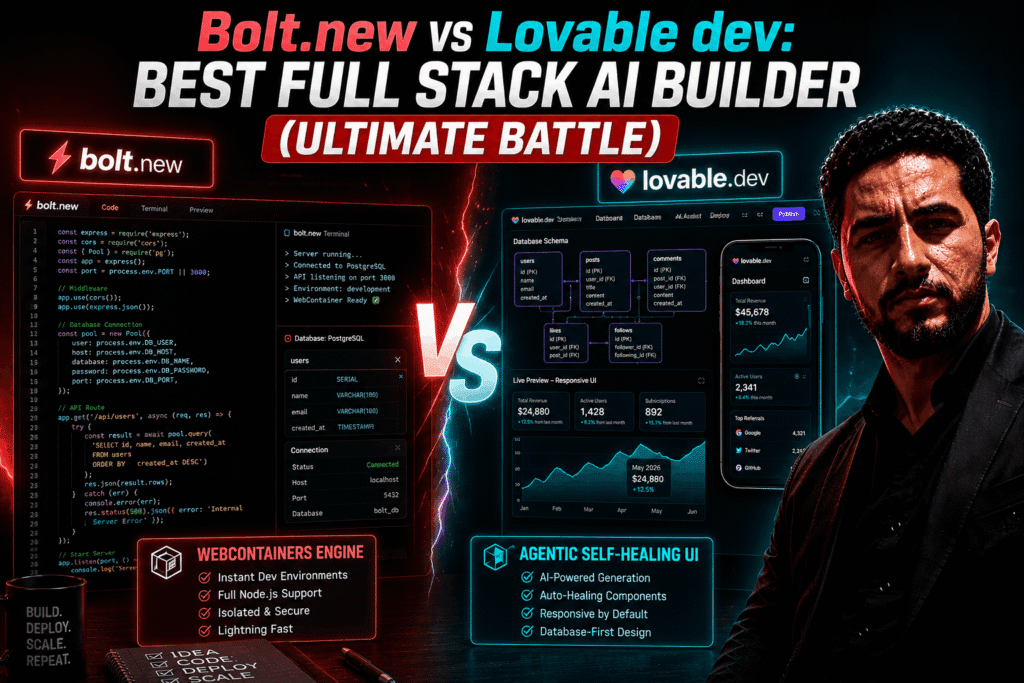
When evaluating Bolt.new vs Lovable dev for rapid application engineering, which is the best full-stack AI builder? While both agentic platforms successfully compile production-grade apps from scratch in a single run, Lovable.dev provides a superior user experience (UX) for independent software creators. Our sandbox engineering tests deploying a dynamic ‘Caffeine Tracker’ utility demonstrate that Lovable features a native desktop-to-mobile preview toggle and autonomous multi-file error self-healing loops. Furthermore, Lovable offers native, fluid integrations for Supabase and GitHub databases, whereas Bolt.new requires supplementary extensions or continuous browser-window toggling to achieve the same operational state.
The Agentic Code-Generation Matrix
The integration of Large Language Models (LLMs) with automated developer workspaces has introduced a competitive race between specialized development engines. In this technical evaluation, we break down the definitive infrastructure battle: Bolt.new vs Lovable dev: Best Full Stack AI Builder. Both tools represent a monumental shift away from static visual templates, employing autonomous agents capable of scaffolding databases, deploying production servers, and resolving dependencies in real time.
For indie hackers, software architects, and agile product managers, picking the right baseline IDE agent can dictate how quickly a minimum viable product (MVP) transitions into a live, scalable commercial application. To provide a rigorous analysis that goes beyond generic feature checklists, we stress-tested both execution spaces using an identical deployment prompt to construct a functional full-stack consumer application.
                              [The App Concept Prompt]
                                         |
        _________________________________|_________________________________
       |                                                                   |
       v                                                                   v
   [Lovable.dev Environment]                                    [Bolt.new Container Engine]
       |                                                                   |
       ├── Autonomous Error Self-Healing                                   ├── Single-Run Successful Build
       ├── Native Mobile/Desktop Toggles                                  ├── Static Screen Canvas Mode
       └── Built-in Supabase + Git Sync                                    └── Requires Chrome Extensions
Inside the Sandbox: The “Caffeine Tracker” Deployment Test
To separate practical everyday coding reality from marketing hype, we executed a parallel sandbox building test across both platforms. The directive was straightforward: Build a data-driven full-stack ‘Caffeine Tracker’ web application featuring real-time data entry log forms, persistent consumer dashboards, and scalable storage configurations.
The core operational results revealed highly distinct engineering paths for each development agent. In the Lovable dev workspace, the initial generation loop encountered a standard structural compiling error. However, without a single line of manual code intervention, the platform’s multi-file autonomous loop recognized the log break and instantly self-healed the error patch. In contrast, Bolt.new completed the exact framework cleanly on its very first try. However, as the building journey advanced into system refinement and live synchronization, structural usability differences quickly emerged.
Deep Dive Architecture: Real Usability and Structural Differences
When inspecting the cross-platform capabilities of Bolt.new vs Lovable dev, development friction boils down to three primary software architectural considerations:
1. Viewport Testing and Layout Adaptability
A massive developer experience (DX) win identified for Lovable AI during our live application run is its native view configuration framework. Software builders can instantly switch between absolute desktop displays and realistic mobile screen previews with a single click. This capability allows creators to debug UI scaling anomalies dynamically. Bolt.new, on the other hand, lacks an immediate native viewport preview system, forcing developers to manually inspect elements or resize windows to verify responsive mobile presentation layers.
2. Database Integration Friction (Supabase Ecosystem)
Managing persistent client data requires an uncompromised database pipeline:
-
Lovable.dev: Integrates with Supabase seamlessly right out of the box. Database tables, user tokens, and secure encryption states sync natively without forcing the user out of the central conversation interface.
-
Bolt.new: Though fully capable of processing the same relational data models, it forces developers into a fragmented workflow. Users must continuously bounce back and forth between the Bolt development window and the external Supabase console to manage active system schemas.
3. Repository Versioning and GitHub Synchronization
For serious production cycles, code repository versioning must be seamless. Lovable handles cloud synchronization smoothly, treating the connected repository as a direct mirror. Bolt.new introduces unnecessary friction here: it forces developers to install third-party plugins—specifically the ‘Bolt to GitHub’ Google Chrome Extension—to securely handle repository handshakes. For developers trying to avoid tool bloat, this external requirement makes the setup feel less integrated.
Feature Matrix: Comparing the Full-Stack Engineering Rivals
Technical Link Building Strategy: Connecting the Knowledge Nodes
To maximize your understanding of these individual application building ecosystems and explore our standalone operational reports, access our dedicated sandbox profiles below:
-
Read the Standalone Powerful Bolt.new Review
Discover our explicit deep-dive testing StackBlitz’s core WebContainer processing capabilities, local file dependency installations, and enterprise Model Context Protocol (MCP) integrations.
-
Read the Standalone Ultimate Lovable.dev Review
Explore our hands-on review tracking 2FA authentication, multi-file code execution modules, and pricing credit efficiency for individual creators running extensive side projects.
The Verdict: Which Agent Wins the Ultimate Battle?
When concluding our definitive analysis of Bolt.new vs Lovable dev: Best Full Stack AI Builder, the final verdict depends heavily on your workflow priorities. If your architectural goal is driven by local browser sandboxing running ultra-fast Node operations inside individual WebContainers, Bolt.new remains an incredibly powerful option.
However, for developers who value fluid user experiences, rapid UI adjustments, and effortless workspace syncing, Lovable.dev stands out as the highly user-friendly winner. Its ability to seamlessly toggle device viewports, automatically heal its own code errors, and connect natively to Supabase and GitHub without clunky third-party plugins makes it an unparalleled engine for modern application delivery.
Launch Your Sandbox Workspace: Begin your automated software development journey and input your own custom application requirements directly via the official StackBlitz Bolt Environment or scale your designs on the Lovable AI App Builder.
Frequently Asked Questions (FAQ)
1. Is Lovable dev better than Bolt.new for mobile app optimization? Yes. Lovable provides a distinct competitive advantage for mobile development by offering a built-in toggle to seamlessly switch between desktop and mobile previews, a feature currently missing in Bolt.new.
2. Can I sync Bolt.new directly to GitHub without external tools? No. To securely manage source control repositories without complex command lines, Bolt.new requires users to implement the specific ‘Bolt to GitHub’ Chrome extension.
3. How does error handling compare between Bolt.new vs Lovable dev? While Bolt.new is excellent at deploying stable configurations on the first try, Lovable dev features advanced autonomous self-healing capabilities that can automatically detect and correct compiling errors mid-generation without user intervention.bolt-new-vs-lovable-dev-best-full-stack-builder