


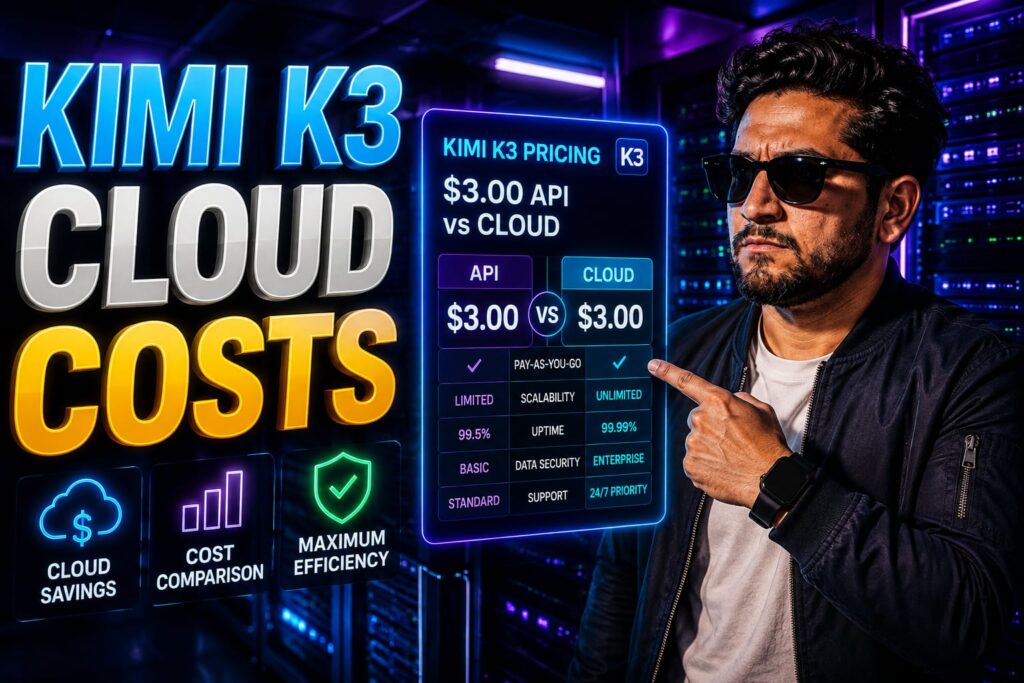
When enterprise engineering teams evaluate new artificial intelligence models in 2026, the discussion immediately shifts from raw intelligence to infrastructure economics. Moonshot AI recently released Kimi K3, a massive 2.8-trillion-parameter Mixture-of-Experts (MoE) model that rivals the world’s best proprietary systems. However, deploying a model of this magnitude requires careful financial planning. Understanding Kimi K3 API pricing and its complex cloud architecture requirements is essential for CTOs deciding between managed API access and self-hosted on-premise deployment. In this comprehensive guide, we will break down the exact token costs, cache discounts, and the heavy multi-node GPU server clusters required to run this reasoning engine in production.
1. The Official Kimi K3 API Pricing Structure
For teams that want to avoid managing heavy server infrastructure, Moonshot AI offers a managed API endpoint. The Kimi K3 API pricing is extremely competitive when compared directly to models like Anthropic’s Claude Opus 4.8 or OpenAI’s GPT-5.6 Sol.
The most disruptive feature of Kimi K3’s pricing model is that it offers a massive, flat 1-million-token context window with absolutely no long-context surcharges.
| Token Type | Price per 1 Million Tokens |
| Input (Cache Miss) | $3.00 |
| Input (Cache Hit) | $0.30 |
| Output | $15.00 |
Source: Moonshot AI Official Pricing (July 2026)
While the base input and output rates place it in the same premium bracket as Claude Sonnet 5, the true enterprise advantage lies in its cache economics.
2. The Power of Prompt Caching Economics
At first glance, $3.00 per million input tokens might seem standard, but the 90% cache discount drastically changes the overall financial math. When building agentic workflows, your AI often needs to read the exact same massive codebase, financial report, or general news database repeatedly.
With Moonshot’s caching system, the first time you upload a 500,000-token enterprise document, you pay the standard input rate. However, for every subsequent query made within the cache window, the cost plummets to just $0.30 per million tokens. According to Artificial Analysis, coding workloads on Kimi K3 often achieve a 90%+ cache hit rate, bringing the effective blended rate down to roughly $2.31 per million tokens. If you are building automated AI cybersecurity tools that continuously scan the same server logs, this caching mechanism will save your business thousands of dollars monthly.
3. Self-Hosting Kimi K3: Cloud Architecture Requirements
While the managed API is cost-effective, many Tier-1 USA and UK enterprises demand strict data sovereignty, opting to download the open-weight model. However, “open-weight” does not mean zero cost.
Kimi K3 operates on a Stable LatentMoE architecture containing 2.8 trillion total parameters, with approximately 104 billion parameters active during generation. Moonshot AI utilizes MXFP4 weight quantization to keep the footprint manageable, but it is still a colossus.
Independent infrastructure testing conducted in July 2026 by imec provides a concrete look at the required cloud architecture:
-
The KV Cache Bottleneck: The raw MXFP4 checkpoint requires roughly 1.4 Terabytes of storage.
-
GPU Node Requirements: In testing, an enterprise 8x Nvidia B200 node could not fit the 1.4TB checkpoint while leaving enough High Bandwidth Memory (HBM) headroom for the KV cache.
-
The Recommended Setup: To run Kimi K3 smoothly, cloud architects had to upgrade to an 8x Nvidia B300 node, which provides 2.3TB of total HBM.
Renting or purchasing 8xB300 multi-node clusters involves a massive upfront capital expenditure, plus the cost of networking, power, and on-call DevOps operations.
4. Alternative Access: The Kimi App Tiers
If your organization does not require direct API access or self-hosted cloud deployment, Moonshot AI offers robust consumer and enterprise application subscriptions. These tiers are perfect for individual developers or small agile teams.
| Subscription Tier | Monthly Cost | Key Features |
| Adagio (Free) | $0 | Basic chat, 1 concurrent agent task |
| Allegretto | $39 | 2x agent credits, Kimi Code access |
| Allegro | $99 | 15x Kimi Code credits, 1M context, Swarm (parallel agents) |
| Vivace | $199 | Max Swarm concurrency, largest quotas |
The $99/month Allegro tier is particularly notable in the B2B space, as it reportedly matches Anthropic’s $200 enterprise plan regarding raw coding quotas.
5. Managed Cloud APIs vs. Self-Hosting Strategy
Ultimately, mastering your Kimi K3 API pricing strategy comes down to predicting your traffic utilization.
If your platform experiences highly variable, spiky traffic, using Moonshot’s managed API (or a high-uptime third-party provider like OpenRouter, which offers it for $2.90 per million input tokens) is the safest financial route. You only pay for the exact tokens you consume, bypassing the immense hardware depreciation risks.
Conversely, if your enterprise processes a continuous, 24/7 stream of highly sensitive data (such as proprietary software engineering or internal legal review), investing in an 8xB300 Kubernetes-native cluster is justified. The fixed hardware capacity will eventually undercut the API costs at maximum utilization.
Conclusion
Kimi K3 is an architectural marvel that bridges the gap between open-weight accessibility and top-tier proprietary intelligence. Whether you leverage the 90% prompt caching discount through the API, or engineer a massive multi-GPU cloud cluster for on-premise deployment, Kimi K3 offers the flexibility and raw reasoning power required to dominate the 2026 software landscape.
Frequently Asked Questions (FAQs)
Q1. How much does Kimi K3 cost per task compared to other models?
Answer: According to the Artificial Analysis Intelligence Index, Kimi K3 costs roughly $0.94 per completed task. This makes it more cost-effective than GPT-5.6 Sol ($1.04) and Claude Opus 4.8 ($1.80), though it is more expensive than smaller models like GLM 5.2.
Q2. What is the actual Kimi K3 API pricing for large documents?
Answer: The base rate is $3.00 per million input tokens and $15.00 per million output tokens. However, Kimi K3 supports a 1-million-token context window with a massive cache discount, dropping cached input reads to just $0.30 per million tokens.
Q3. Can I run Kimi K3 on a standard AI server?
Answer: No. Due to its 2.8 trillion parameters and 1.4TB checkpoint size, a standard 8xB200 server lacks the necessary KV cache headroom. Cloud architects recommend deploying it on an 8xB300 node (2.3TB total HBM) for stable production throughput.