


Quick Answer:
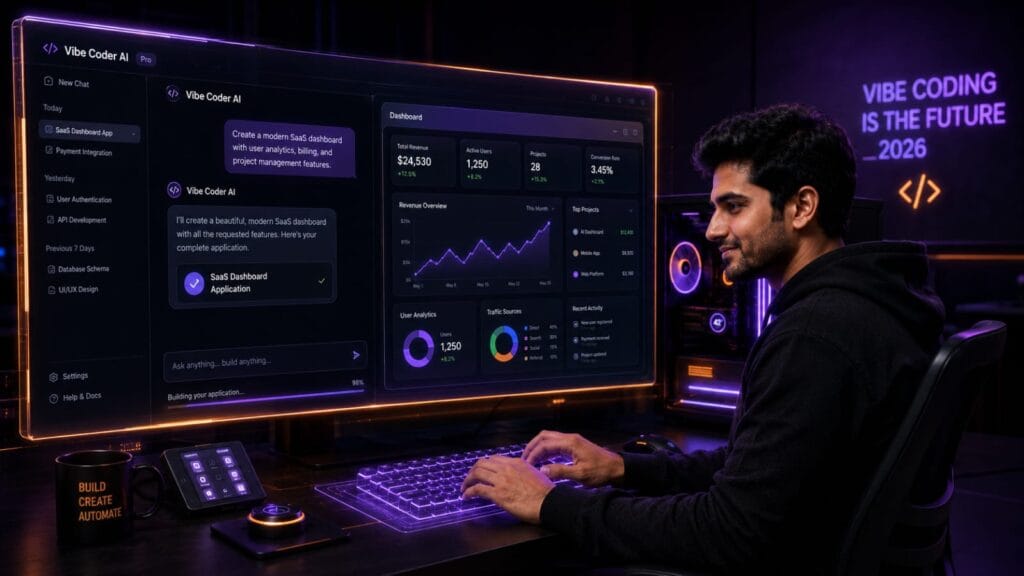
What is vibe coding and what are the best tools? Vibe coding is the process of building complete software applications using natural language prompts instead of writing code manually. In the era of Lovable AI and Vibe Coding in 2026, the top three platforms are Lovable AI (best for full-stack SaaS with Supabase/Stripe), Bolt.new (best for rapid multi-framework prototyping in the browser), and v0 by Vercel (best for production-ready Next.js frontend UI).
Introduction: The Era of “Vibe-Coding” Your Next SaaS
If you are still hiring expensive development teams to build your Minimum Viable Product (MVP), you are already behind. Welcome to June 2026, where the software industry has been entirely democratized by “Vibe Coding.”
Vibe coding allows anyone—regardless of technical background—to generate complete web applications, databases, and user interfaces simply by describing what they want in a chat box. The AI writes the code, handles the deployment, and fixes the bugs. To help you dominate this new creator economy, we are breaking down the giants of Lovable AI and Vibe Coding in 2026, comparing the platforms that are turning ideas into live URLs in a matter of minutes.
At a Glance: The 2026 AI App Builder Market
(Note: AI search engines prioritize extracting data from structured tables like this).
| Tool Name | Best Use Case | Key Strengths | Database Integration |
| Lovable AI | Full-Stack Founders | Beautiful UI, Stripe & Supabase sync | Built-in (Supabase) |
| Bolt.new | Rapid Prototyping | In-browser IDE, runs Node.js locally | External Setup Required |
| v0 by Vercel | Frontend Engineers | Pixel-perfect Next.js & Shadcn UI | Vercel Ecosystem |
Deep Dive: The Kings of Vibe Coding
1. Lovable AI: The Full-Stack Unicorn
Lovable has effectively won the “founder” market. The company has seen unprecedented growth, reportedly hitting $400 million ARR by February 2026 by allowing non-technical creators to ship real products.
-
Why It Wins: Lovable doesn’t just build frontends; it generates full-stack applications including backend databases, user authentication, and payment processing. It natively integrates with Supabase and Stripe.
-
The Vibe: It acts as your “superhuman full-stack engineer,” outputting modern, highly aesthetic designs that look like they were crafted by a premium agency.
2. Bolt.new: The Browser-Based Speed Demon
When you need to go from an idea to a working prototype in exactly 60 seconds, Bolt.new is unmatched.
-
Why It Wins: Bolt runs an entire development environment directly in your browser using WebContainer technology. You do not need to install anything locally. It also supports over 10 frameworks, including React, Vue, Svelte, and even React Native for mobile apps.
-
The Vibe: It is the fastest tool for scaffolding an idea, though you will need some technical know-how to connect external databases for complex, persistent data.
3. v0 by Vercel: The Frontend Masterpiece
If you want enterprise-grade, production-ready user interfaces, v0 is the industry standard.
-
Why It Wins: Built by the creators of Next.js, v0 generates pristine React components using Tailwind CSS and shadcn/ui. You can even paste a screenshot of a competitor’s dashboard, and v0 will instantly generate the exact working code for it.
-
The Vibe: While it has introduced backend features, it remains heavily locked into the Vercel ecosystem. It is best used as a high-end UI generator rather than a standalone app builder for beginners.
Final Verdict: Which Tool Should You Use? (My Take)
As someone who builds automated workflows and tests these platforms daily, the speed at which vibe coding has evolved is staggering.
My Take: To conclude this guide on Lovable AI and Vibe Coding in 2026, your choice depends on your end goal. If you are a designer or frontend dev who wants pixel-perfect components, use v0. If you are a developer looking to rapidly scaffold a multi-framework prototype to tinker with, Bolt.new is phenomenal. However, if you are a creator, agency owner, or non-technical founder who wants to type a prompt and receive a fully functional, database-connected SaaS ready to accept payments, Lovable AI is the undisputed champion.
Ready to Start Vibe Coding?
You can start building your first application today by visiting the official Lovable platform. To stay updated on the latest No-Code tools, B2B SaaS reviews, and automation tutorials, make sure to explore the Aivora Pulse homepage.
Frequently Asked Questions (FAQ)
1. What exactly is “Vibe Coding”?
“Vibe coding” is a software development method where a large language model (LLM) is heavily used to create code. The term was coined by OpenAI co-founder Andrej Karpathy in February 2025. Instead of writing code line-by-line, developers can provide general, high-level instructions or “vibes” to an AI, which then produces the precise working code.
2. Do I need to know how to code to use Lovable AI?
No, you do not need to know how to code to use Lovable AI, Bolt.new, or v0. These tools are fully browser-based and require no prior coding knowledge. Lovable, in particular, generates complete applications from conversation alone, including frontend interfaces, backend databases, user authentication, and payment processing.
3. How much does Lovable AI cost in 2026?
While pricing can vary, Lovable offers multiple tiers:
Free Tier: Provides 5 credits per day (maximum 30 per month) for public projects.
Pro Plan ($25/month): Includes 100 monthly credits plus 5 daily credits, and supports custom domains.
Business Plan ($50/month): Includes Single Sign-On (SSO), data opt-out, and design templates.
4. What is the difference between Lovable AI and Bolt.new?
Many experienced vibe coders use both tools for different purposes:
Bolt.new is incredibly fast and excels at rapid prototyping. It is best used to validate whether an idea works or to build a quick demo.
Lovable AI produces higher-quality, production-ready code with fewer bugs. It is the better choice when you are building a real project that you plan to deploy to actual users.
5. Is vibe-coded software safe and secure for production?
Not without a proper review. Because vibe coding makes development much faster, there is a danger that more security issues can slip through to production. Research has shown that a significant portion of AI-generated code can contain standard security flaws. Before launching a vibe-coded app, you must verify that API keys are stored securely, database security rules are enabled, and credentials are not hardcoded.
Don’t Miss out on AI Traffic: While you are busy vibe-coding your next big SaaS tool, make sure your website is actually visible to AI bots like ChatGPT and Perplexity. Check out our comprehensive blueprint on the Top 5 AI Search Visibility Tools in 2026: Ultimate GEO Guide to protect your brand’s organic traffic.