


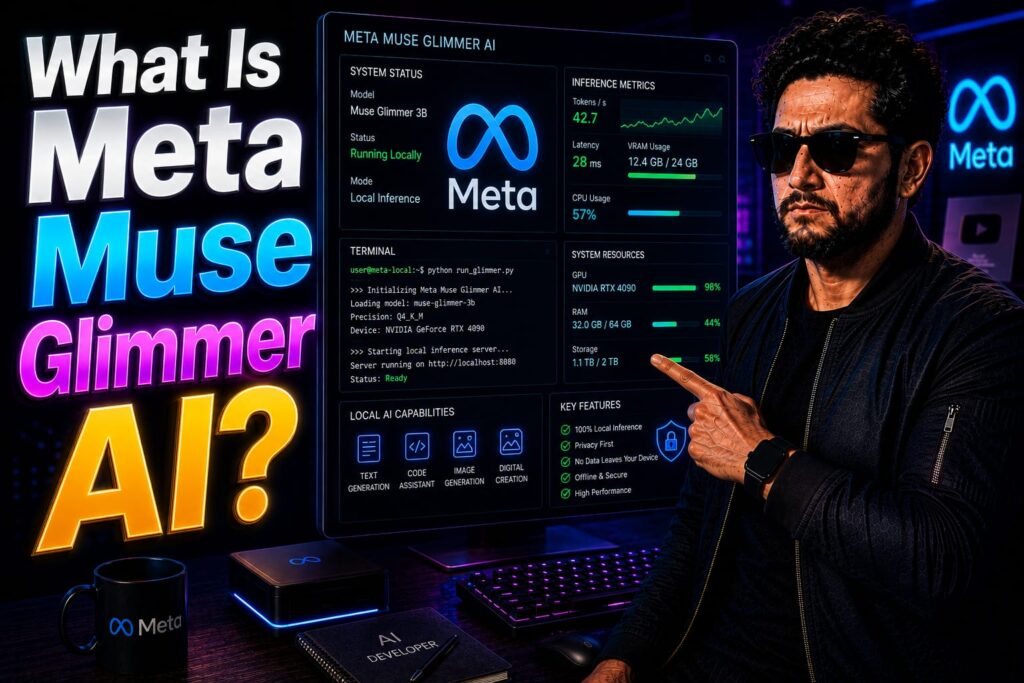
The artificial intelligence landscape has reached a decisive turning point in late 2026, proving that sheer model size is no longer the sole metric of meaningful innovation. While frontier laboratories continue to push the boundaries of multi-billion-parameter cloud systems, the practical demand for accessible, lightweight, and local AI solutions has skyrocketed. Designed to run on a standard PC or Mac equipped with a single consumer graphics card, this launch signals a massive step forward for developers, privacy-conscious enterprise teams, and creators who want autonomous workflow assistance without relying on costly cloud API endpoints. In this comprehensive guide, we will explore how Meta Muse Glimmer AI is specifically engineered to execute complex tasks directly on consumer-grade desktop hardware, forever changing the economics of machine learning.
1. What Is Meta Muse Glimmer AI?
Unlike traditional large language models (LLMs) that require massive server clusters and racks of enterprise GPUs, Meta Muse Glimmer AI is a highly optimized 30-billion-parameter causal language model equipped with a dedicated perception encoder. Distilled from the massive Muse Spark foundation model, it is purpose-built for autonomous agentic tasks on consumer hardware. At its core, the model focuses on agentic functionality—the ability to plan, break down, and execute multi-step workflows autonomously rather than merely responding to single-turn text prompts.
This represents a monumental shift for local artificial intelligence. Historically, running a local model meant accepting heavily degraded reasoning capabilities. Now, developers can integrate multi-step logic, reliable tool use, multimodal document understanding, and autonomous failure recovery into a single, cohesive model that runs entirely locally. It bridges the gap between high-end cloud intelligence and on-device data sovereignty.
2. Key Capabilities and Core Architecture
The system is released under the highly permissive Apache 2.0 license, meaning independent developers and commercial enterprises alike can modify, fine-tune, and monetize their custom implementations without facing restrictive vendor lock-in.
To understand its massive impact, we must look at its core architectural advantages:
-
Agentic Task Specialization: The model is not just a chatbot; it is pre-tuned for complex tool use, structured JSON function calling, desktop application automation, and continuous multi-step reasoning.
-
Advanced Distillation and Efficiency: It leverages state-of-the-art model distillation techniques. By compressing the deep reasoning capabilities of its larger predecessors into a lightweight footprint, it maintains operational precision without requiring a supercomputer.
-
Open-Weight Flexibility: Delivered with fully accessible model weights, it enables developers to perform LoRA (Low-Rank Adaptation) fine-tuning. This allows teams to customize the system for highly specific domain applications, such as medical data parsing or legal contract review.
-
Accessible Hardware Requirements: The model is optimized to run efficiently on standard consumer workstations. A typical setup featuring a single NVIDIA RTX series GPU (with 16GB to 24GB of VRAM) or an Apple Silicon M-series Mac can run inference smoothly.
For developers looking to download the raw weights and view the official technical documentation, you can visit the official Hugging Face repository.
3. The Shift From Cloud Training to On-Device Inference
This release comes at a moment when industry infrastructure investments are fundamentally rebalancing. For years, the primary bottleneck in the artificial intelligence sector was computational training capacity—tech giants spent billions building ever-larger models on vast GPU clusters. Today, as enterprise solutions transition from experimental pilots into active, daily production, the emphasis has shifted dramatically toward real-time execution, commonly known as inference.
According to recent industry forecasts, global spending on AI inference has officially surpassed model training expenditures. When autonomous agents operate in real-time—browsing local databases, drafting code, and orchestrating desktop applications—running every single query through cloud servers creates unsustainable bandwidth limitations and latency overhead.
By optimizing Meta Muse Glimmer AI specifically for multi-step task execution on localized compute, Meta directly addresses this bottleneck. This optimization allows organizations to offload continuous inference tasks directly to user endpoints. This localization trend aligns perfectly with the rising demand for decentralized design workflows, a topic we recently covered in our extensive guide on the Best AI Website Builders in 2026.
4. Real-World Use Cases for Developers and Creators
Moving away from theoretical benchmarks, how can digital business owners and software engineers actually use this technology today? The applications for local agentic models are vast and immediately actionable.
First, consider automated content curation and technical SEO analysis. Marketing teams can run local background scripts that securely monitor industry RSS feeds, scrape proprietary data points, and draft comprehensive content outlines without ever sending a single query through a public API. This keeps upcoming product strategies completely hidden from cloud providers.
Second, software developers can integrate these desktop agents directly into their Integrated Development Environments (IDEs). The agent can continuously index local code bases, run automated debugging scripts in the background, and suggest architectural refactors securely. Because the model operates locally, proprietary enterprise code never leaves the company’s internal network.
Finally, executives can deploy local workflow bots acting as personal assistants. These bots can autonomously organize local file directories, summarize confidential PDF documents, and manage desktop tasks while preserving absolute user privacy.
5. Benchmarking and Performance Metrics
When evaluating open-weight models, performance benchmarks are crucial to understanding real-world viability. In standard industry evaluations, this 30-billion-parameter model punches significantly above its weight class. By focusing heavily on quality data curation during the pre-training phase and applying rigorous reinforcement learning from human feedback (RLHF) tailored to agentic workflows, it routinely matches or outperforms closed-source models that are three times its size.
Particularly in coding benchmarks like HumanEval and multi-step reasoning tests such as GSM8K, the model shows exceptional accuracy. Furthermore, its specialized perception encoder allows it to process multimodal inputs—such as screenshots of a user’s desktop or charts embedded in a local document—with remarkable speed. This multimodal capability ensures that when the agent is asked to automate a desktop task, it actually “sees” the UI elements it needs to interact with, drastically reducing hallucination rates and execution errors. This level of performance, previously reserved for massive server-side models, democratizes enterprise-grade AI for anyone with a capable desktop computer.
6. Why Local Agentic Models Matter for Enterprise Security
For technology platforms, small businesses, and independent software engineers, adopting local agentic workflows unlocks several transformative advantages that cloud-only providers simply cannot match:
-
Total Data Privacy and Governance: When dealing with sensitive financial data, internal code repositories, or protected health information, compliance risks associated with external cloud transmissions are a massive hurdle. Local execution drastically reduces these risks, ensuring regulatory compliance.
-
Zero Per-Token API Costs: Cloud-hosted APIs bill users for every token generated. During iterative agentic loops—where an AI might make dozens of hidden queries to solve a single problem—these costs can scale exponentially. Local models allow continuous, unlimited background execution with a predictable zero-marginal-cost overhead.
-
Offline Resilience and Near-Zero Latency: Local models respond instantaneously without relying on active internet connections or suffering from server throttling during peak hours, making them ideal for edge computing applications and remote field operations.
Final Verdict
The highly anticipated debut of Meta Muse Glimmer AI vividly demonstrates that the future of artificial intelligence isn’t exclusively about giant, centralized cloud datacenters—it is equally about sovereign, accessible, and ultra-fast on-device intelligence. As inference workloads continue to dominate global compute consumption, compact open-weight models designed specifically for agentic tasks will form the new backbone of everyday productivity. For developers, creators, and enterprise IT leaders worldwide, the ability to run powerful, autonomous agents directly on a local machine is no longer a distant ambition; it is an immediate reality.
Frequently Asked Questions (FAQs)
Q1. What hardware is required to run this new model? Answer: It is optimized to run on standard consumer workstations equipped with a single consumer graphics card, such as NVIDIA RTX series GPUs (with 16GB+ VRAM) or Apple Silicon M-series Macs.
Q2. Is this model free for commercial use? Answer: Yes, it is released under the permissive Apache 2.0 license, meaning developers can use it commercially, modify it, and redistribute it without restrictive enterprise licensing fees.
Q3. How does it differ from standard LLMs? Answer: It is an agentic model, meaning it is specifically trained to execute multi-step workflows, manage local files, use API tools, and recover from execution errors autonomously, rather than just generating single-turn text responses.