


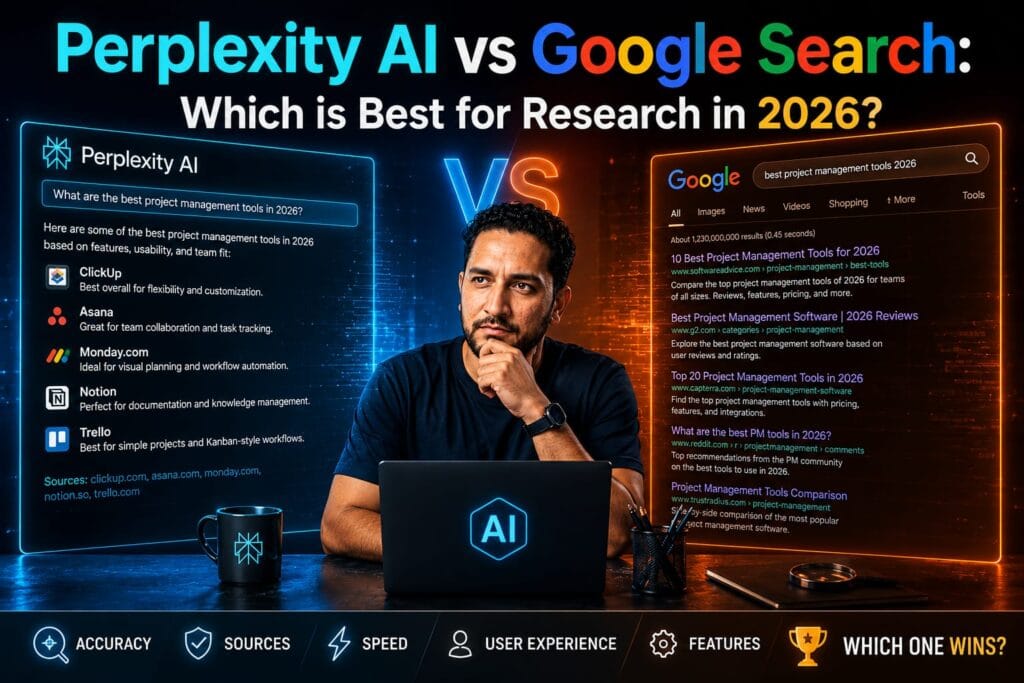
Quick Answer: The fundamental difference between Perplexity AI vs Google Search comes down to Synthesized Answers vs. Link Dumping. While Google forces users to click through multiple blog posts to manually extract information, Perplexity acts as an automated research assistant—reading dozens of pages instantly to deliver a direct, cohesive answer backed by clear source citations.
The Bangalore Pizza Test: Links vs. Answers
Imagine you are looking for the absolute best place to eat a authentic pizza in Bangalore.
If you input this query into Google, the search engine will instantly throw a list of 50 different links at you. To get a real answer, you have to open at least 10 different food blogs, scroll through endless introductory paragraphs, and manually deduce which specific pizza shop everyone is praising. Google doesn’t give you a straight answer; it makes you do all the investigative legwork.
Now, take that exact same query to Perplexity. Instead of dumping links, Perplexity acts as a personal research assistant. It reads those 15 to 20 different food articles for you, analyzes the consensus, and delivers an instant response: “Based on local food blogs, these 3 spots are highly recommended.” You get a definitive, structured answer immediately, rather than a maze of websites to navigate. This practical use case perfectly highlights the core dynamic when comparing Perplexity AI vs Google Search.
How Perplexity AI Processes Complex Queries


Perplexity bypasses the traditional search routine by executing an automated three-step synthesis pipeline:
-
Live Web Parsing: It deploys advanced scrapers to pull the freshest data regarding your prompt.
-
Cross-Reference Analysis: It reads multiple independent sources simultaneously to find overlapping facts.
-
Cohesive Summarization: It packages the finalized conclusion into clean, conversational prose, completely eliminating the need for manual tab switching.
This shift toward answering conversational queries directly is changing the landscape of online indexing and content consumption.
Google’s Traditional Index: Why It Feels Slow Now

Google’s business model has historically relied on directing traffic to external sites via indexed hyperlinks. While Google has introduced features like Featured Snippets and AI Overviews, its primary layout still prioritizes ad placements and structured search lists.
For quick informational research, this multi-tab approach is starting to feel incredibly tedious for modern users who expect immediate results without wading through heavily monetized ad space.
Citations and Fact-Checking: Can You Trust the Sources?
A major advantage that sets Perplexity apart from standard LLM chatbots is its transparent approach to verification. Every statement it writes is accompanied by a small, clickable citation number that links directly to the source webpage. This hybrid structure gives you the speed of an AI summary along with the accountability of traditional search, allowing you to quickly verify information if something looks questionable.
Feature Comparison: A Side-by-Side Sandbox Breakdown
To evaluate how these platforms handle daily research tasks, here is a functional breakdown based on real sandbox testing performance:
| Feature Layer | Traditional Google Search | Perplexity AI Engine |
| Primary Output | Lists of Indexed Hyperlinks & Ads | Synthesized Conversational Answers |
| User Effort | High (Requires opening multiple tabs) | Low (Delivers instant summaries) |
| Source Verification | Manual validation required | Embedded Inline Citations |
| Research Speed | Slower (Great for deep manual browsing) | Extremely Fast (Excellent for instant context) |
| Best Used For | Direct Navigation, Shopping, & Local Maps | Deep Concept Research & Multi-Source Synthesis |
Monetization Setup: Scaling Your Tech Content
Publishing high-signal comparison guides, technical analyses, and AI research workflows requires an incredibly fast, secure hosting backend that can comfortably manage sudden traffic spikes when your articles index.
To host your tech portals and automation blogs safely, you can secure reliable cloud servers at a massive discount. Use my direct referral link to Get Hostinger at a Discount and lock in an exclusive 20% discount on premium hosting architectures built for top-tier speed and scaling stability.
Inside the Sandbox Interlinking Note: If you want to take your content visibility to the next level so your own site gets cited by these platforms, read my comprehensive guide on AI Optimization to discover how to align your content strategy with modern LLM scrapers.
Conclusion: The Future of Everyday Research
The comparison between Perplexity AI vs Google Search isn’t about which tool is universally superior; it’s about matching the tool to your specific intent. Google remains a powerful utility for navigational search, local maps, and direct commercial shopping queries. However, for users seeking clear answers extracted from complex internet data without the hassle of opening dozens of tabs, conversational AI platforms are quickly setting a new standard for online discovery.