



Quick Answer:
Is v0 by Vercel worth it for web development? Yes, v0 by Vercel is a highly efficient AI-powered front-end generation engine optimized for rapid UI prototyping, responsive scaffolding, and one-click cloud deployment. However, hands-on sandbox testing reveals clear operational limitations: while it drastically accelerates structural design and initial coding workflows for smaller applications, its customization layer remains restricted for advanced engineering tasks that demand granular architectural design, complex state-management, and deep proprietary branding.
The Promise of Zero-Effort Front-End Generation
In the high-velocity software ecosystem of 2026, writing a comprehensive v0 by Vercel Review requires analyzing how text prompts translate into functional web engineering. Marketed as an accessible bridge between design ideas and responsive layouts, v0 promises to streamline front-end creation for both independent software builders and enterprise developers.
The core marketing pitch is highly attractive: write a simple text description or upload an interface screenshot, and watch the engine output clean code using Next.js and Tailwind CSS. But does it truly deliver on this promise? To find out, we put the platform through a rigorous sandbox testing matrix to establish this unfiltered v0 by Vercel Review to see if it justifies your development capital.
But does it truly deliver on this high-stakes promise, or is it merely another generic UI generator wrapped in hype? To find out, we put v0 through a rigorous sandbox testing matrix to evaluate whether it genuinely justifies your time, effort, and subscription capital.
Inside the Sandbox: My Personal Coding Verdict
Let’s break through the mainstream corporate marketing fluff. After conducting rigorous, direct implementation tests on v0 by Vercel, my unfiltered stance is clear: this tool is an absolute powerhouse for rapid prototyping and spinning up clean structural layouts, but it comes with sharp constraints that advanced developers must understand.
If your goal is to build simple utility tools, clean landing pages, or functional UI mockups that you can deploy to the cloud with a single click, v0 is an exceptional, time-saving engine. However, do not expect it to act as a complete substitute for a seasoned software engineer. The AI-generated content can occasionally border on the generic, lacking that specialized, highly tailored aesthetic that bespoke brands demand. Furthermore, the granular customization options quickly become restrictive if you are trying to micro-tune deeply integrated state-management structures or highly specific visual themes.


[Text Prompt or UI Screenshot Input] -> [v0 Generative Engine Layer]
                                                   |
                                                   v
                       [One-Click Vercel Edge Network Deployment]
                                                   |
                                                   v
         [Ideal for Fast Prototyping | Limited for Deep Enterprise Overhauls]
The Functional Advantages of v0 by Vercel
During our live deployment evaluations, several structural features highlighted why v0 is highly regarded in the developer community:
-
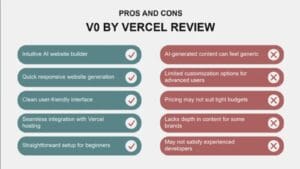
Frictionless Setup & Interface: The initial configuration pipeline is remarkably direct. For entry-level builders or non-developers, the clean, minimalist workspace eliminates the steep learning curve traditionally associated with configuring local node environments.
-
Airtight Vercel Hosting Integration: The true magic of v0 lies in its native pairing with the Vercel ecosystem. Once the engine finishes generating your component layers, launching the codebase live onto premium cloud servers requires a single click, completely removing hosting friction.
-
Exceptional Velocity: For wireframing, building internal admin dashboards, or creating responsive layouts, the speed at which v0 translates general ideas into clean component files is outstanding.

The Limitations: Where the Engine Falls Short
Despite its undeniable speed, advanced technical users will encounter clear boundaries when building complex web architecture:
-
Algorithmic Content Saturation: The text, iconography, and image placements generated natively by the model can frequently feel uniform. It lacks the dynamic visual depth, custom asset mapping, and premium human nuance required for award-winning custom web apps.
-
Restricted Customization for Power Users: While modifying the baseline layout via iterative prompting is supported, senior front-end engineers trying to inject strict architectural paradigms or highly tailored components will find the interface restrictive.
-
The Cost-to-Value Proposition: While the entry tiers are reasonably priced, developers operating on a tight budget might find alternative open-source code assistants or localized language models more cost-effective, providing more expansive feature sets for complex code repos.
Comparative Matrix: High-Velocity Prototyping vs. Enterprise Customization
| Feature Parameter | v0 Operational Capability | Enterprise Development Requirement |
| Deployment Velocity | Outstanding (One-click server publishing) | Standard (CI/CD pipeline validation loops) |
| Design Originality | Standardized (Shadcn & Tailwind heavy) | High (Bespoke layouts & brand identities) |
| Component Depth | Perfect for isolated blocks and mockups | Complex (Deeply integrated system states) |
| Target Audience | Beginners, Indie Builders, Fast Hackers | Senior Architects, Tech Lead Teams |
Final Verdict: Should You Implement v0 by Vercel?
Ultimately, v0 by Vercel stands out as an exceptional utility framework, provided you deploy it with the correct expectations. If your current operational roadmap demands rapid deployment, layout experimentation, and clean component structural code without manual overhead, v0 is absolutely worth your consideration.
Conversely, if you are an experienced systems engineer who demands meticulous control over every layout file, script bundle, and custom interaction layer, you will likely view it as a stepping stone rather than a permanent development home. It is a brilliant tool for scaling small to mid-tier visual projects, but it does not fully replace the necessity of deep human code optimization.
Master Cross-Platform AI Battles: To discover how this frontend powerhouse holds up when pitted directly against the ultimate autonomous reasoning loops of Anthropic, check out our highly requested v0 by Vercel vs Claude Fable 5: Best AI UI Generator interface teardown.
Explore the Production Framework: Review the official documentation, deployment rules, and latest framework updates directly on the authorized Vercel v0 Development Platform.
Frequently Asked Questions (FAQ)
1. Can non-developers use v0 by Vercel to build full websites?
Yes. The platform is engineered to translate simple english descriptions or uploaded interface mockups into working web designs, and its native one-click deployment makes it highly accessible for beginners.
2. Does v0 support advanced code customization?
Only to a certain extent. While you can modify layouts using subsequent text prompts, experienced developers may find the interface restrictive when attempting to inject highly complex state logic or unique design specifications.
3. What technologies does v0 use to generate frontend components?
v0 primarily generates modern, responsive frontend code utilizing React, Next.js, Tailwind CSS, and structured components powered by the Shadcn UI library.