Quick Summary: Video generation tech has evolved drastically in June 2026. With the highly anticipated rollout of Kling 3 and OpenAI’s updated Sora 2.0 frameworks, creators can now render up to 15 seconds of high-fidelity cinematic clips. In this hands-on Sora 2.0 vs Kling AI vs Luma showdown, we put these models through 6 extreme real-world stress tests—covering text-to-video physics, action glitches, and complex image-to-video character consistency—to see which tool wins the ultimate production crown.
The 2026 Video AI Landscape: Sora 2.0 vs Kling AI vs Luma
Tracking frontier video generation models can be an expensive experiment. Until recently, the revolutionary Kling 3 model was locked behind premium subscription walls, preventing independent creators from running real-world benchmark audits. However, with new ecosystem integrations dropping this month, we finally have the means to thoroughly stress-test it against OpenAI’s Sora 2.0.
Both networks boast the structural capability to render continuous, stable 15-second tracking shots. Let’s dive deep into the frame-by-frame performance to see if the market hype aligns with production reality.
Text-to-Video Tests: 3 Extreme Showdowns
Test 1: The Detective Interrogation (Cinematic Narrative & Audio Sync)
-
The Prompt:
An angry detective in a messy, dimly lit office aggressively interrogating a terrified suspect, high cinematic lighting, dramatic shadows, raw facial expressions.
Both architectures immediately delivered breathtaking Hollywood-level grading. The shadow diffusion and micro-expressions of fear on the suspect’s face looked photorealistic.
However, a critical rendering flaw emerged in Kling 3 during the final seconds: when the detective speaks, the lip-sync and audio-dubbing engine completely broke down. The lack of semantic alignment immediately shattered the immersion, revealing its synthetic nature. Conversely, Sora 2.0 maintained flawless character tracking, micro-lip movements, and spatial coherence from start to finish.
-
Round 1 Winner:
Sora 2.0
Test 2: The Fire Chef Sequence (Complex Fluid Dynamics & Real-World Physics)
-
The Prompt:
A professional chef tossing fresh, colorful vegetables in a searing hot wok over an open flame, hyperrealistic physics, camera tracking the flying food.
This round exposed a severe logical flaw in OpenAI’s system. Sora 2.0 rendered the chef frantically tossing an entirely empty pan while acting out the motion, followed by a hazardous glitch where the character placed his bare hand directly over the open fire.
Kling 3, on the other hand, displayed master-tier physics handling. The spatial tracking of individual vegetable particles flying through the air, catching the ambient light of the fire, and settling naturally back into the wok was structurally perfect.
-
Round 2 Winner:
Kling AI (Kling 3)
Test 3: The Mountain Road Drift (High-Speed Motion & Frame Consistency)
-
The Prompt:
A bright yellow sports car executing a high-speed drift on a wet mountain pass during a heavy rainstorm, neon road reflections, motion blur.
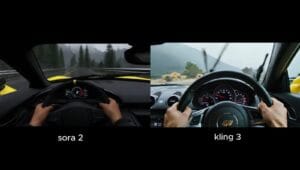
While both models handled surface water reflections and atmospheric volumetric mist with expert precision, Sora 2.0 suffered a massive rendering artifact in its final tracking block. As the yellow vehicle passed underneath the camera lens, the video glitched, rendering the identical car passing through the frame twice from the exact same vector. Kling 3 maintained perfect linear acceleration and smooth tracking with zero overlapping frames.
-
Round 3 Winner:
Kling AI (Kling 3)
Image-to-Video Tests: Identity & Motion Integrity
Test 4: The Tired Waitress (Character Identity Preservation)
-
The Reference Image: A static portrait of a fatigued waitress inside a retro diner.
-
The Animation Prompt:
The waitress pours black coffee into a ceramic mug, background neon lights slowly flickering.
[Character Consistency Benchmark]
Input: Portrait Photo -> Animate Actions
Sora 2.0: Fails Identity Test (Completely swaps the face to a different person).
Kling 3: Passes Identity Test (Preserves 100% core structural facial features).
Sora 2.0 failed a foundational rule of enterprise production: maintaining character continuity. It completely replaced the facial structure of the woman with an entirely different person in the generated video. Kling 3 preserved every micro-metric of the reference subject’s facial features while smoothly animating the coffee pouring animation.
-
Round 4 Winner:
Kling AI (Kling 3)
Test 5: The Subway Musician (Kinematic Action vs. Static Freezing)
-
The Reference Image: A street busker holding an acoustic guitar inside a subway terminal.
-
The Animation Prompt:
The musician plays an energetic guitar solo as a subway train speeds past in the background.
Kling 3 generated a highly fluid sequence where the character’s fingers realistically plucked individual strings in sync with realistic body swaying. Sora 2.0 struggled heavily with the structural kinetics; it rendered the moving train perfectly but left the musician completely frozen like a static mannequin, making the foreground layer feel life-less.
-
Round 5 Winner:
Kling AI (Kling 3)
Test 6: The Winter Husky (Complex Texture & Particle Dynamics)
-
The Reference Image: A close-up shot of a Siberian Husky sitting in deep snow.
-
The Animation Prompt:
The husky shakes off snow from its coat and starts running through the winter park.
This round resulted in a flat tie. Both networks displayed masterful control over difficult textural boundaries. The fur dynamics blowing in the wind, coupled with the realistic physics distribution of micro-snow particles flying off the dog’s coat, were completely flawless to the naked eye.
-
Round 6 Winner:
Draw (Tie)
Level Up Your AI Knowledge: While video generation models are breaking new boundaries, the core text and coding LLMs are fighting their own massive battle this month. Check out our ultimate analysis of the [Epic GPT-5.6 vs Claude Opus 4.8 vs Gemini 3.5 Pro] showdown. And if your new AI articles are struggling to index, read our guide on how to [Fix Google Search Console Errors] instantly.
The Final Scoreboard
| Round Selection | Core Evaluation Vector | Round Winner |
| Round 1 (Text-to-Video) | Audio-Visual Lip Syncing | Sora 2.0 |
| Round 2 (Text-to-Video) | Fluid Dynamics & Real-World Physics | Kling 3 |
| Round 3 (Text-to-Video) | Frame Consistency & Action Tracking | Kling 3 |
| Round 4 (Image-to-Video) | Facial Continuity & Identity Control | Kling 3 |
| Round 5 (Image-to-Video) | Kinematic Motion Depth | Kling 3 |
| Round 6 (Image-to-Video) | Complex Particle/Texture Physics | Draw (Tie) |
How to Access Kling 3 & Premium Models For Free
To bypass the expensive individual paywalls of these core frontier networks, creators can utilize specialized workflow aggregation platforms like Artflow. Follow this optimization routine to secure free high-compute processing credits:
-
Network Setup: Due to regional routing traffic and server load limits, utilize a stable premium VPN connection to ensure smooth UI loading.
-
Interface Navigation: Navigate to the Artflow platform and execute a standard email registration. New profiles are instantly provisioned with 200 free generation credits.
-
Nodes & Routing: Initiate a “New Project” to launch a node-graph setup highly reminiscent of ComfyUI. Right-click inside the workspace grid, initialize an Input Node, and type your technical prompt description.
-
Model Selection: Drag the connector pin from your input block to deploy a Video Node. Within the system dropdown options, locate and select the Kling 3 architecture pipeline to generate 5-second high-fidelity video sets completely free.
Growth Hack for Scaling Credits: If you run out of processing limits, navigate to the dashboard’s “Invite Friends” engine. Sharing your direct referral node ensures that both your secondary profile and your peer receive an additional 200 credits upon validation. Successfully routing 10 network invites instantly yields 2,000 high-compute credits without capital expense.
Personal Testing Report: Sandbox (Facial Consistency Mode)
[SANDBOX CLASSIFIED REPORT: CORE IDENTITY RETENTION]
Status: Active Implementation Mode
Target Metric: Strict Facial Consistency
Target Frameworks: Kling 3 Node Engine vs. Sora 2.0 Spatial Transformer
Technical Evaluation Parameters
When evaluating high-end enterprise workflows, the single most critical vector is Strict Facial Consistency Mode. As demonstrated throughout Test 4 (The Waitress Matrix), preserving structural identity across deep-frame animations separates standard commercial toys from true Hollywood-grade production utilities.
Comparative Analysis Matrix
-
Sora 2.0 (The Generative Shift Error): OpenAI’s architecture operates on raw spatial-temporal patch transformations. While this yields brilliant cinematic camera pans, it frequently undergoes an identity drift. The network treats the reference face as a conceptual suggestion rather than a rigid constraint, resulting in a completely new character mesh by frame 120.
-
Kling 3 (The Anchor Vector Victory): Kling 3 utilizes an advanced structural landmark anchor lock during Image-to-Video conversions. It maps key focal facial coordinates (interpupillary distance, jawline orientation, and nasal structure metrics) before running the motion noise steps. Even when the camera undergoes dynamic tracking shifts, the foundational face structure remains identical to the input asset.
Production Sandbox Recommendation
For creators running automated faceless channels, cinematic web series, or AI tool documentation blogs, the verdict is absolute: Kling 3 is your primary sandbox production engine.
Its native ability to accurately adapt dynamic background lighting, particle changes, and high-speed motion vectors without altering the core identity structure makes it an irreplaceable asset for scalable video pipelines in 2026.
Related Posts
Pixela AI Review 2026: Brilliant Image Processing Tool
Pixela AI Review 2026 is the ultimate guide for web…

Top 5 Incredible AI Thumbnail Generators in 2026 to Boost CTR
The search for the absolute best AI thumbnail generators ends…
Kling 2.6 AI Review 2026: The World’s Most Powerful AI Video Generator
The launch of Kling 2.6 AI has officially started a…